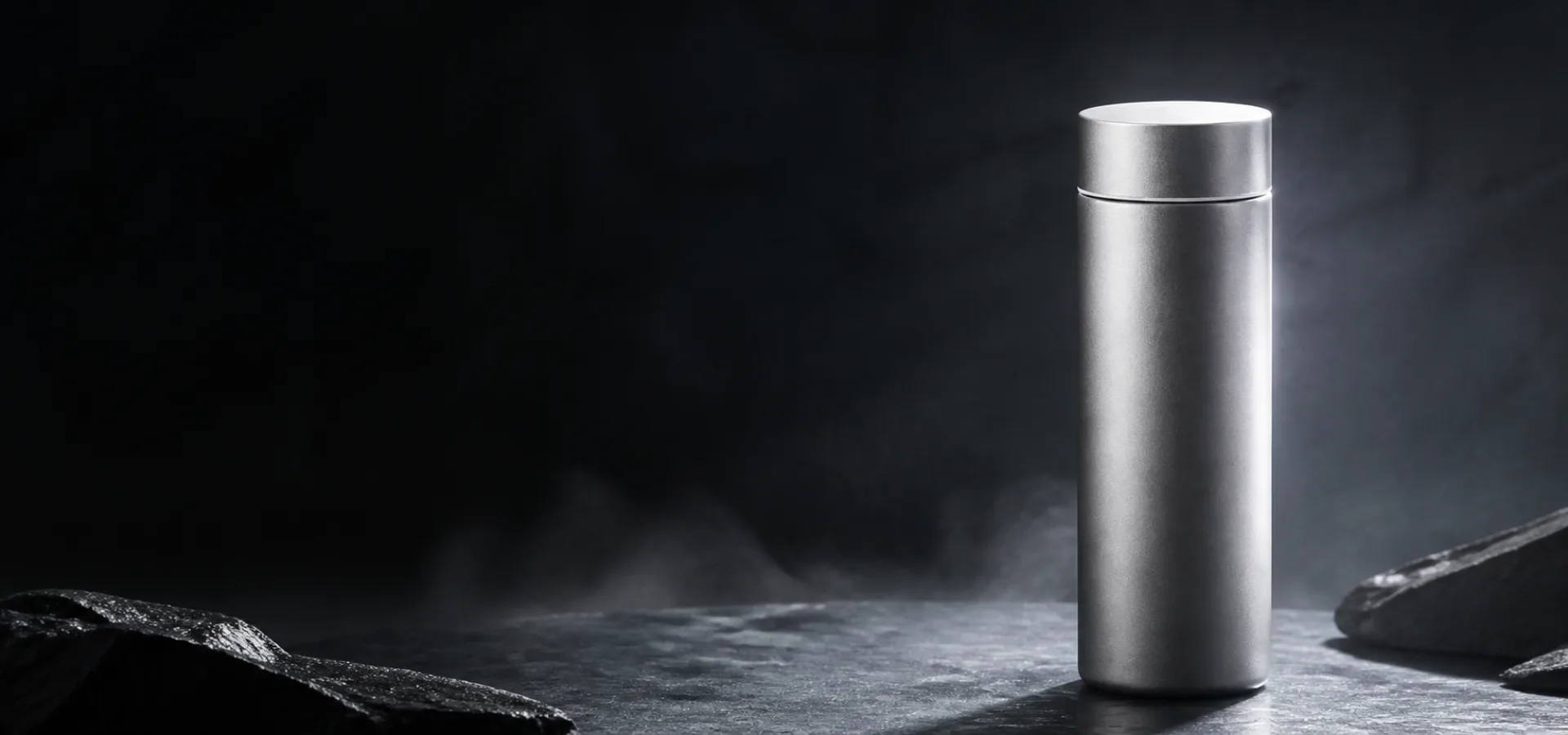
Sourcing a custom titanium water bottle involves more than comparing a unit price. Buyers also need to define the product correctly, verify what the manufacturer can produce, agree on an approval process and understand which commercial details are included in the quotation.
A clear purchasing brief reduces misunderstandings before sampling begins. It also makes quotations from different suppliers easier to compare. This checklist is designed for brand owners, importers, distributors, corporate gift companies and other B2B buyers sourcing titanium drinkware for the United States or Europe.
1. Define the Product Before Requesting a Price
A manufacturer cannot prepare a reliable quotation from a request such as “Please quote a titanium bottle.” The intended product needs to be described in enough detail for the supplier to identify the correct construction, accessories, finish and packaging.
Your initial brief should state:
- Intended use, such as retail, corporate gifting or a private-label collection
- Preferred bottle capacity
- Approximate dimensions, if the product must fit a cup holder, bag or retail display
- Lid style and drinking method
- Preferred exterior color or finish
- Logo position and expected branding method
- Individual packaging requirements
- Estimated order quantity
- Target market
- Required delivery date
- Reference photographs or drawings
If some details are undecided, identify them as open questions. An experienced OEM/ODM team can then discuss possible directions without assuming that an unconfirmed specification is final.
Buyers can review the Titanium Collection before preparing an RFQ and use relevant models as visual references.
Representative options include the 420ml Titanium Tea Infuser Bottle, Pure Titanium Water Bottle HC-TI-100 and 420ml Pure Titanium Vacuum Tea Bottle. Final materials, construction and commercial terms should be confirmed for the selected model.
2. Request a Written Material Specification
The word “titanium” alone is not a complete material specification. Before approving a product, ask the supplier to state the exact material used for every relevant component.
The written specification should identify:
- Titanium grade used for the bottle body
- Material used for the lid
- Material used for seals, straws and other accessories
- Internal and external construction
- Surface treatment
- Wall thickness and finished product weight
- Whether any non-titanium components contact the beverage
These technical details must be confirmed for the selected model. Buyers should not rely only on a product title, photograph or general marketing description.
Where material documentation, testing or market-specific compliance is required, include that requirement in the RFQ. Ask the supplier which documents are available for the exact product and material combination being quoted. Do not assume that a report for one model automatically applies to another model.
3. Specify the Customization Scope
OEM customization can involve several separate decisions. Listing each one prevents important work from being omitted from the quotation.
Product configuration
Confirm the preferred capacity, body shape, lid system, accessories and available colors. If the project requires a new structure instead of an existing model, clearly identify it as an ODM development request.
Branding
Provide a vector logo file where possible and specify the intended logo size, position and color. Ask the manufacturer to confirm which branding methods are available for the chosen product.
Do not select a process based only on an online example. The suitable method may depend on the product surface, logo detail, order quantity and expected appearance.
Packaging
State whether the product requires a standard box, custom retail packaging, a gift box or another format. Include inserts, instruction sheets, barcodes, labels and shipping marks in the brief.
For US and European retail programs, the buyer should provide the exact language, warning, labeling and barcode requirements that apply to the sales channel.
More information about the development workflow is available on the OEM / ODM Service page.
4. Ask for Model-Specific Commercial Terms
Important purchasing terms should be shown in writing and connected to the exact model being quoted.
Your quotation request should cover:
- Model number and product specification
- Order quantity and unit price basis
- Customization and packaging included in the price
- Tooling or setup costs, if applicable
- Sample cost and sample lead time
- Bulk production lead time
- Payment and trade terms
- Quotation validity
- Carton dimensions and units per carton
- Net and gross carton weight
Model-specific MOQ is not confirmed in this article and should be requested directly. MOQ may depend on the chosen model, finish, branding and packaging configuration.
For HCUP Drinkware / Yongkang Miling projects, the stated bulk production lead time is 30–40 working days. The stated payment arrangement is 30% deposit, with the remaining 70% paid before shipment. Buyers should still confirm when the production period begins and whether it starts after the deposit, sample approval, artwork approval or completion of all three.
5. Verify Factory Capacity Against Your Project
Large capacity numbers are useful only when buyers understand what they cover. Ask whether the stated capacity applies to the whole factory, a product category or the exact model under review.
HCUP Drinkware / Yongkang Miling operates a real manufacturing facility with the following confirmed business information:
- Factory area: 20,000 m²
- Employees: 150+
- Reported factory-wide monthly capacity: 1,000,000+ units
- OEM/ODM support: Available
- Main export markets: United States and Europe
These figures provide a starting point for supplier evaluation, but a buyer should still discuss current production scheduling, model-specific capacity and the required delivery window.
Authentic factory information and photographs can be reviewed on the Factory Capabilities page.
6. Establish a Sample Approval Process
A sample should be evaluated against a written specification rather than appearance alone.
Before approving the sample, check:
- Dimensions, capacity and product weight
- Material declaration
- Lid fit, operation and seal placement
- Surface finish and color
- Logo size, position and appearance
- Accessories and packaging structure
- Labels and printed content
- Workmanship and agreed functional tests
Record approved details in a signed specification, approved sample or another controlled document. If changes are made after approval, confirm whether they affect price, production time, packaging or testing.
The final approved reference is often called a “golden sample.” Ask how it will be identified and used during bulk inspection.
7. Agree on Quality-Control Checkpoints
Quality expectations should be agreed before production, not after the goods are completed.
A practical quality plan can identify:
- Incoming-material checks
- First-production or pre-production confirmation
- In-process inspections
- Finished-product inspection
- Packaging and carton checks
- Pre-shipment inspection
Ask which characteristics will be inspected, how samples will be selected and what happens if a result does not meet the approved specification.
The inspection plan should reflect the actual product. Any claim involving material composition, insulation performance, leak resistance, durability or compliance should be supported by model-specific information agreed between the buyer and manufacturer.
8. Confirm Packaging and Logistics Data
Packaging affects freight cost, product protection and warehouse handling. Buyers should request carton data before placing the order, especially when comparing landed costs.
Confirm:
- Individual box dimensions
- Units per export carton
- Export carton dimensions
- Net and gross weight
- Protective packaging
- Shipping marks
- Pallet requirements, if applicable
- Barcode and labeling placement
- Final trade term and required shipping documents
Do not estimate freight from product dimensions alone. Final packaging can change the shipment volume substantially.
9. Use a Structured RFQ
The following format can be copied into an enquiry:
Product: Custom titanium water bottle
Target market: United States / Europe
Intended use: Retail / corporate gift / private label
Preferred capacity: To be confirmed
Estimated quantity: [Insert quantity]
Material requirement: Please confirm the exact titanium grade and all component materials
Lid requirement: [Describe or attach reference]
Color and finish: [Insert requirement]
Logo: [Method to be discussed; attach vector artwork]
Packaging: [Standard box / custom retail box / gift box]
Required documents or testing: [List exact market or customer requirement]
Delivery target: [Insert date]
Please quote: Unit price, MOQ, sample cost, sample lead time, production lead time, packaging data, payment terms and trade terms
A structured RFQ gives the manufacturer enough information to respond usefully and reduces repeated clarification.
Supplier Comparison Scorecard
| Evaluation area | What to verify |
|---|---|
| Product fit | Can the supplier produce the required model and configuration? |
| Material clarity | Are material details stated in writing? |
| Customization | Are logo, finish and packaging options clearly defined? |
| Sampling | Is there a documented approval process? |
| Quality control | Are inspection stages and acceptance criteria explained? |
| Production | Is capacity discussed in relation to your order and schedule? |
| Commercial terms | Are MOQ, lead time, payment and inclusions clear? |
| Communication | Are questions answered specifically and consistently? |
Frequently Asked Questions
What is the MOQ for a custom titanium water bottle?
MOQ must be confirmed for the selected model and customization plan. Include the expected quantity, finish, logo and packaging in your RFQ so the supplier can provide a project-specific answer.
How long does bulk production take?
HCUP Drinkware / Yongkang Miling states a bulk production period of 30–40 working days. Confirm the production start point and final schedule for each purchase order.
What are the payment terms?
The stated terms are 30% deposit and 70% balance before shipment. Confirm the payment details in the formal quotation and purchase agreement.
Does HCUP Drinkware support OEM and ODM projects?
Yes. OEM/ODM support is available. The feasibility, development work and cost depend on the selected product and customization requirements.
Which technical details still need confirmation?
The exact titanium grade, model dimensions, wall thickness, weight, lid materials, available finishes, logo methods, MOQ, sample terms, packaging data and product-specific test documentation must be confirmed for the selected model before quotation or ordering.
Prepare Your Titanium Bottle RFQ
A successful titanium drinkware project begins with a precise brief and a transparent approval process. Provide the intended market, estimated quantity, product references, branding requirements, packaging needs and delivery target when contacting the manufacturer.
HCUP Drinkware / Yongkang Miling supports OEM/ODM drinkware projects for US and European buyers through a real 20,000 m² factory with 150+ employees and reported factory-wide monthly capacity of more than 1,000,000 units.
Request a Quote to discuss your custom titanium water bottle project, or explore the Titanium Water Bottle Manufacturer page before submitting your specifications.
Continue your sourcing research
Relevant product collection · OEM / ODM Process · Factory Capability